Medicube PDRN vs Collagen: Which Range Is Right for You?
By the Medicube Reviews editorial team · product data refreshed 1 October 2026 · how we rank
We have not tested the products in this guide. Everything here is read from the listings, the published ingredient lists and what buyers report, not from hands-on use. What that means.
PDRN Pink and Triple Collagen are Medicube's two biggest ranges, and they are the ones shoppers most often mix up. They look similar, they cost about the same, and both promise better-looking skin. But they are built for different jobs. Here is what each one does, who it suits, and why plenty of people happily use both.
What the PDRN Pink range is
PDRN stands for polydeoxyribonucleotide, and Medicube's version is marketed around salmon DNA PDRN paired with pink peptides and niacinamide. The pitch is glow, bounce and barrier support: skin that looks plumper, more even and freshly facialled. The PDRN Pink serum is the viral hero with tens of thousands of ratings, and the range fans out into a toner, an eye cream, a moisturiser, a cleanser and more, so you can go as deep into it as you like.
In plain terms, reach for PDRN if your main wish is radiance and a comfortable, resilient-feeling barrier. It is the range people buy when they want that dewy, lit-from-within finish.
What the Triple Collagen range is
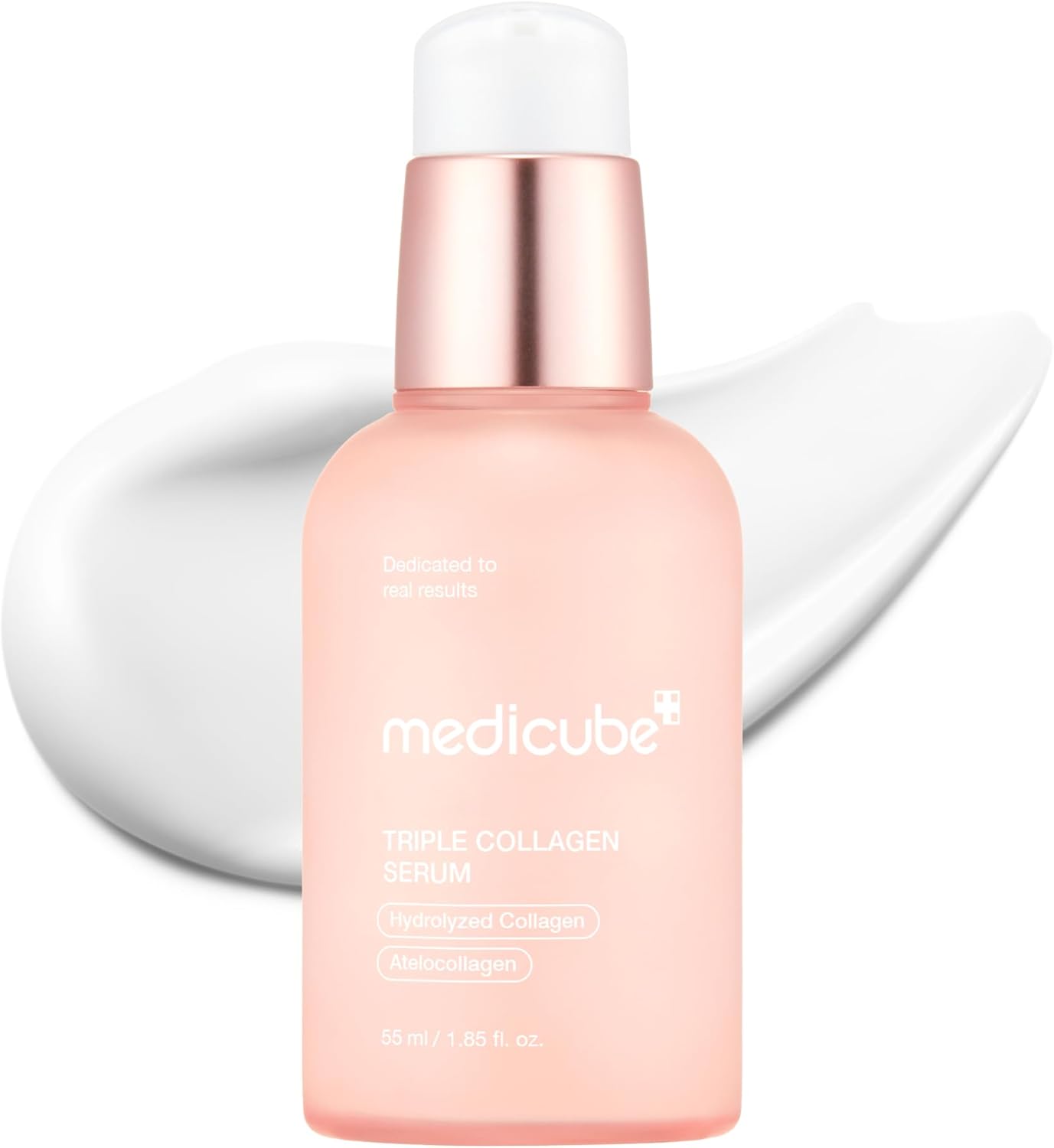
The Triple Collagen range is the hydration-and-firmness play, built on three collagen types plus supporting humectants. It leans classic and lightweight: a serum, a toner, a cream and a jelly that layer cleanly and rarely upset sensitive skin. The goal is a smoother, more cushioned, firmer-feeling base rather than an obvious glow.
Choose Collagen if your priority is simple, reliable hydration and a serum that plays nicely under everything else, morning or night. It is the sensible, no-drama option for people who mainly want their skin to feel plump and comfortable.
Which one suits your skin
If you are chasing glow, radiance and barrier comfort, start with PDRN Pink. If you are chasing hydration, softness and a firmer feel without shine, start with Triple Collagen. Oily and combination skin often prefers the lighter Collagen textures; dull or tired skin tends to notice more from PDRN. Neither is a strong active, so both are friendly to beginners and to reactive skin.
From the ranges this guide covers
Our order, ranked by Amazon rating and review volume.


Amazon.co.uk figures, not ours: prices read on 2026-10-01; star ratings and review counts read on 2026-10-01. Prices and ratings change; these are dated snapshots.
What an expert says about this
A cosmetic chemist on what PDRN is and where the evidence actually sits, which is the same limit we set out above. This is general expertise, not a review of this page and not an endorsement of anything on it.
"What is PDRN and Does it Work? Cosmetic Chemist Explains" by Glow By Ramón. Not our video and not a Medicube one. Loaded from YouTube when you press play.
Can you use both together?
Yes, and many people do. A common approach is PDRN Pink in the evening for glow and recovery, and Triple Collagen in the morning for lightweight hydration under sunscreen. Because neither range is a harsh exfoliant or a high-strength active, layering them is low-risk. If you would rather keep things simple, pick the range that matches your top concern and build out from there rather than buying both at once.
If you only buy one thing
Start with a single serum. The PDRN Pink serum is the better first buy if you want the most-loved, glow-focused hero, and the Triple Collagen serum is the better first buy if you want dependable hydration that suits any routine. You can always add a toner or cream from the same range later once you know you like it. See the head-to-head in our PDRN Pink vs Triple Collagen serum comparison.
See our picks
Top picks: Best PDRN & Salmon DNA, Best Serums & Toners.
Compare: medicube Salmon DNA PDRN Pink vs medicube Triple Collagen Serum 55ml
Compare: medicube Salmon DNA PDRN Pink vs medicube Zero Exosome Shot 7,500
Compare: medicube Triple Collagen Serum 55ml vs medicube Triple Collagen Serum 4.0
Compare: medicube Salmon DNA PDRN Pink vs COSRX Advanced Snail 96 Mucin
Or browse PDRN & Salmon DNA, Serums & Toners.
PDRN Pink and Triple Collagen, side by side
| PDRN Pink | Triple Collagen | |
|---|---|---|
| Products in the range | 18 | 7 |
| Best-reviewed pick | medicube Salmon DNA PDRN Pink | medicube Triple Collagen Serum 55ml |
| What that pick scores | 4.6/5 from 24k ratings | 4.7/5 from 4k ratings |
| Price band | entry to mid | entry to mid |
| Formulas we could read | 13 of 18 | 5 of 7 |
| Named ingredient in the front half of its own list | 6 of 13 | 2 of 5 |
Every figure here is read from the product data and the published ingredient lists when the page is built, not written by hand. The last row is the one worth pausing on: it counts how often the ingredient a product is named after actually sits in the front half of its own list.
Common questions
Is Medicube PDRN real salmon DNA?
PDRN is made from purified DNA fragments taken from salmon or trout sperm cells, and in skincare it is used as a soothing, skin-conditioning ingredient. One caveat worth knowing: most published PDRN research is on injected PDRN in a clinical setting, and PDRN is a large, negatively charged molecule that does not easily cross the skin barrier, so topical cosmetic versions are a newer and far less studied use. Some Medicube products also offer a vegan pink peptide version that mimics the effect without the marine source. Check the specific product if a vegan formula matters to you, because the range includes both.
Does collagen in skincare actually firm skin?
Topical collagen mostly works as a hydrator and film-former: it holds water at the surface and makes skin feel plumper and smoother in the short term, which reads as firmer. It does not rebuild the collagen in your dermis the way the marketing can imply. For everyday hydration and a softer feel, it does its job well at this price.
PDRN or Collagen for anti-ageing?
Neither is a heavyweight anti-ageing active on its own. PDRN leans towards barrier comfort and glow, collagen towards hydration and a plumper feel. For visible ageing concerns, pair either with the basics that carry the strongest evidence: daily sunscreen first, then a retinoid if your skin tolerates it. Vitamin C is a reasonable extra for tone, though the clinical evidence behind topical vitamin C is thinner than it is for the other two.
Can I layer PDRN and Collagen serums?
Yes. Both are gentle, so you can use one in the morning and one at night, or layer the lighter one first. Start slowly if your skin is reactive, but there is no ingredient clash to worry about between the two ranges.
Where these claims come from
- Applications of Marine Organism-Derived Polydeoxyribonucleotide (2021) · Marine Drugs
- Plasma-Engineered PDRN: why topical use is limited (2025) · Pharmaceutics
- Topical medium-length PDRN in photodamaged skin (2026) · PLOS ONE
- Collagen Based Materials in Cosmetic Applications: A Review (2020) · Materials
- Challenges and strategies for collagen delivery for tissue regeneration · PMC
- The 500 Dalton rule for skin penetration (2000) · Experimental Dermatology
- Sunscreen and prevention of skin aging: a randomized trial (2013) · Annals of Internal Medicine
- Retinoids in the treatment of skin aging (2006) · Clinical Interventions in Aging
- Topical Vitamin C and the Skin (2017) · Journal of Clinical and Aesthetic Dermatology
- The Roles of Vitamin C in Skin Health (2017) · Nutrients
Most published PDRN research studies injected PDRN in a clinical setting. Topical cosmetic PDRN is a newer and far less studied use, because PDRN is a large, negatively charged molecule that does not easily cross the skin barrier.